Showing posts with label Birds. Show all posts

Saturday, June 4, 2011

Puffins and Pemaquid

Have you ever seen a Puffin? They're really cool looking birds, but we've never actually SEEN one until yesterday! 
Check Out That Beak! Photo Credit by www.oddanimals.com

J, C and I joined our friend and her grand-daughter for a 2 1/2 hour drive up to New Harbor, ME, joining a group of homeschoolers from around the state on a Puffin cruise. Despite my, um, navigating "skills", we arrived early and had time to stretch our legs and explore around Shaw's wharf.
J as a Lobster
C as a Happy Clam
Once on the boat, J headed to the top deck with some boys we know, while C stayed on the first deck with the rest of us, meeting some new homeschoolers from the Bucksport area. (We knew it was going to be SUPER chilly up top and opted for the more sheltered botton one.) We cruised to Egg Rock Island in search of Puffins.
The Boat We Went on
On the Way We Went Past This Little Island
And Here's Egg Rock With an Scientists Hut (for Observations) and LOTS of Birds
Our ONE Puffin...Who Flew Around and Finally Landed
We headed back to the dock after seeing some Harbor Seals, walked to the parking lot, and headed to Colonial Pemaquid. We had a picnic lunch on tables by the bay then joined a smaller group of homeschoolers for an educational tour of the fort.

A park ranger explained the ruins seen by the museum and the history of the area, which included French, English and Native American.
Perhaps a Jail or Animal Stockade?


Most People Living in the 1700s Grew Herb Gardens Outside Their Front Doors
And These Gardens Had a Variety of Plants
A man dressed in period clothing conducted the rest of the tour. He was a hoot! Although his stories and information became long at times, the kids were attentive and enjoyed him!
The fort itself has been rebuilt and renamed several times. It was named Charles for the English King for a while and then William Henry, another king, and then Frederick, a general. The current fort was built to replicate the original William Henry.
Some Part of the Fort that was Found
French, USA, Maine, and England Flags - French and English are 1700s
The Story Goes That Enemies Hid Behind this Rock so the Fort Was Built Around it
The bay and the outlying island are named for John Smith - Pocohontos's John Smith - for when he explored this area: John Island and John's Bay. Interestingly, John Smith also coined the phrase "New English" according to our guide.
I think the kids favorite part was learning about tinderboxes and seeing our period-dressed guide shoot his musket. (J got a cool video on his cell phone, but I can't seem to get it uploaded.)
We had a GREAT day! We headed out at 6:45 in the morning and arrived home at 5:30pm - a full, fun, educational experience!

Tuesday, May 31, 2011

Tweet and See: May 2011

It's been a busy, busy month at the feeders! Lots of new species!

We were excited to see a pair of wood ducks this month! They're quite unique and interesting! We LOVE the coloration and patterns on the male!
Male Wood Duck
Female Wood Duck
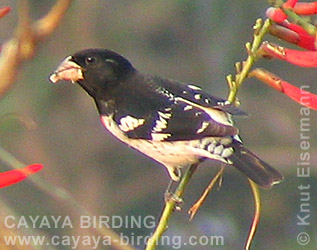
J and I saw a Rose-breasted Grosbeak at the end of our road and then later at our feeders. And C saw a Downy Woodpecker on the neighbor's tree while riding her bike. 2 of these woodpeckers stopped by the feeders the next day.
Rose-breasted Grosbeak  Photo by www.guatemalabirding.com/
birdphotos
cardinals.htm
Downy Woodpecker Photo by commons.wikimedia.org/
wiki
File:Down...emale.jpg
And we flocked - Yes! I couldn't help the word play! LOL - to the bay window to see our first ever Baltimore Oriole and American Goldfinch! Their beautiful yellow colors showed up brilliantly with the evergreen background.
American Goldfinch
Baltimore Oriole
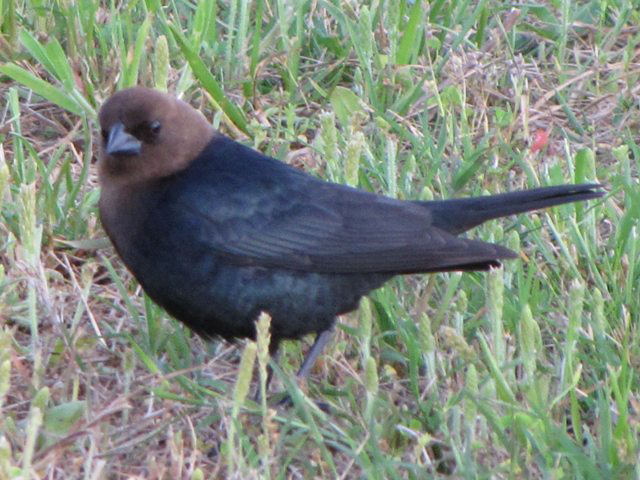
We had 3 new migratory species come to the feeders in one evening: White-crowned Sparrow, Eastern Towhee and Brown-headed Cowbird. Interestingly, the Brown-headed Cowbird is the only "parasitic" bird in Maine, laying its eggs in host bird' nests to raise its young.
White-crowned Sparrow Photo by Al Lemieux
Eastern Towhee Photo by Robert Hawkins
Brown-headed Cowbird Photo by Herb Amyx
On a rainy afternoon we observed a large Turkey Vulture eating in our neighbor's yard. Wow, do they have a LONG wingspan! (Our books says up to 6'!)  And a Common Grackle stopped at our feeders the same day.
Turkey Vulture Photo by Raul Quinones
Common Grackle Photo by Terry Sohl
A Robin is sitting on eggs in a tree near the wooden playset. We're watching for blue eggs on the ground underneath.

May 2011 
Wood Duck*
Black-capped Chickadee
Blue Jay
White-crowned Sparrow*
Eastern Towhee*
Brown-headed Cowbird*
Red-winged Blackbird
Dark-eyed Junco
Red-breasted Grosbeak*
Downy Woodpecker*
Baltimore Oriole*
American Goldfinch*
America Robin
Mourning Dove
Common Grackle*
Turkey Vulture*

 Master List
Red-winged Blackbird
Rusty Blackbird
Black-capped Chickadee 
Common Eider+
American Crow+
American Goldfinch
Baltimore Oriole
Pileated Woodpecker+
Bald Eagle+
Blue Jay
Downy Woodpecker
Red-breasted Grosbeak
Common Redpoll
Dark-eyed Junco
Northern Cardinal
Mourning Dove
American Crow+
Wild Turkey
Red-breasted Nuthatch
Tufted Titmouse
Common Grackle
Turkey Vulture
Gray Jay
Canada Goose+
Great Blue Heron+
Mallard
Herring Gull+
American Goldfinch
American Robin
Ruffed Grouse
Wood Duck

Summer is such a busy time for us, so this is our last Tweet and See until September when we'll have our summer list! 


*denotes new species this month
+denotes saw in an area NOT in our backyard

Saturday, May 7, 2011

Nature Study: Nature's Sounds

It can get noisy around here. Not vehicles and people, but the birds chirping, cawing and singing, and the Spring Peepers with their bird-like croaks, and the brook bubbling down through the evergreens. It's a GOOD noisy though! So, we thought we would share our nature sounds with you!

Although there isn't much to SEE in this video, it's the SOUND that we want you to experience - Spring Peepers just after dark! (Sometimes we have to close our bedroom windows because they get SO loud!)


And we took this short video in the mid-morning hours of our birds. Again, you can't SEE them, but they're certainly there! You can also just make out the brook in the background, a subtle sound. (This is also the area that I also took the Peeper video at night. When I took the other video, the area was flooded though.)

Saturday, April 30, 2011

Tweet and See: April 2011


We've created QUITE a bird sanctuary here! Driving down our dirt road lined with evergreens, you can often see SWARMS of birds flying around our house.  And their different sounds fill the air and mix with the Spring Peepers and Wood Frogs that are out now.


We had TONS of Dark-eyed Juncos, both male and female, visiting our feeders this month. Our trees, lawn and driveway would be scattered with them! 
Dark-eyed Junco - Photo Credit www.indiana.edu
A pair of mallards, swimming in from our flooded backyard from next door, visiting almost daily to eat seed and corn fallen to the ground from the squirrels and birds. We found it interesting that one would crane it's neck, watching, while the other ate, and then they would switch.

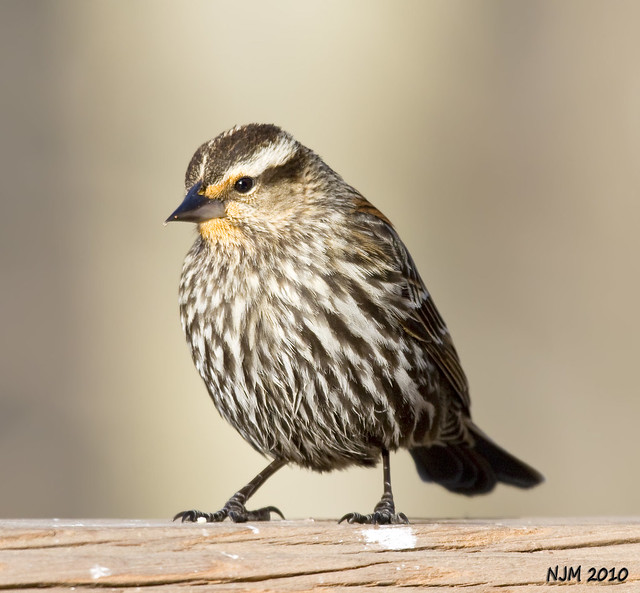
We were VERY excited to see female Red-winged Blackbirds flying around and eating from the feeders. And there are BABIES! The fledglings are just a little bigger than the Juncos, with striped heads and brown-and-white bodies.
Female Red-winged Blackbird - Photo Credit NJM 2010
Male Red-winged Blackbird - Photo Credit Jim Fenton
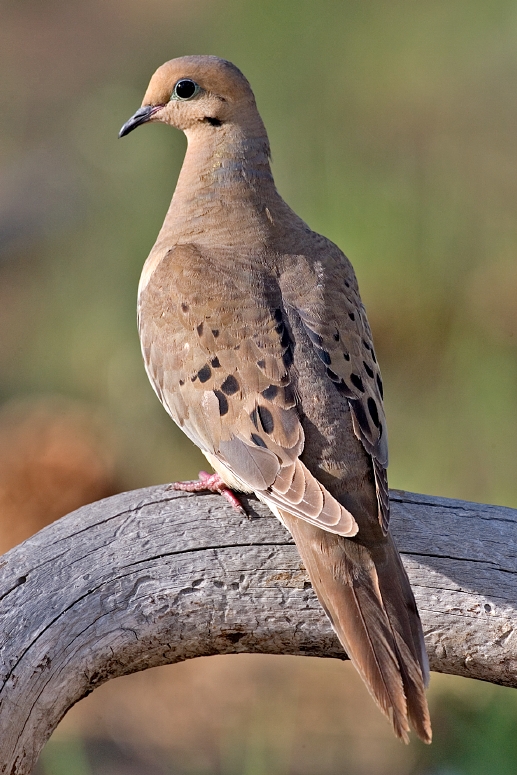
We're now up to 5 Mourning Doves. Oftentimes we can see them roosting on the branches of our crab apple or cherry trees near the feeders, fluffed in the chill. I believe there are 4 females and 1 male.
Mourning Dove - Photo Credit www.naturepicsonline.com
We've been hearing woodpeckers, but haven't seen any to identify. 

We had 2 male purple finches visit the feeders at the end of the month. Their bright red color is easy to see in the dark green evergreens.
Male Purple Finch - Photo Credit by www.myphotoclub.com
April 2011
Red-winged Blackbird
Northern Cardinal
Mourning Dove
Dark-eyed Junco
Blue Jay
Black-capped Chickadee
Rusty Blackbird*
Common Eider*+
Pine Siskin* 
American Crow*+ 
Mallard 
Purple Finch*
America Robin
Donald and Daisy Mallard Visiting Our Feeders
Master List
Red-winged Blackbird
Rusty Blackbird
Black-capped Chickadee 
Common Eider+
American Crow+
Pileated Woodpecker+
Bald Eagle+
Blue Jay
Common Redpoll
Dark-eyed Junco
Northern Cardinal
Mourning Dove
American Crow+
Wild Turkey
Red-breasted Nuthatch
Tufted Titmouse
Gray Jay
Canada Goose+
Great Blue Heron+
Mallard
Herring Gull+
American Goldfinch
American Robin
Ruffed Grouse


*denotes new species this month
+denotes saw in an area NOT in our backyard

Friday, April 1, 2011

Tweet and See: March 2011

March 2011
Blue Jay
Black-capped Chickadee
Tufted Titmouse
Dark-eyed Junco
Mourning Dove
Northern Cardinal
Red-wing Blackbird*
Common Redpoll*
American Robin* 
Mallard Duck*
Red-wing Blackbird - Migrator from Canada

Dark-eyed Male Juncos Ground Feeding
Master List
Red-winged Blackbird
Black-capped Chickadee
American Crow
Pileated Woodpecker
Bald Eagle
Blue Jay
Common Redpoll
Dark-eyed Junco
Northern Cardinal
Mourning Dove
Wild Turkey
Red-breasted Nuthatch
Tufted Titmouse
Gray Jay
Canada Goose
Great Blue Heron
Mallard
Herring Gull
American Goldfinch
American Robin


*denotes new species this month

Tuesday, February 1, 2011

Tweet and See - January's Backyard Birds

I'm joining up with Heather at Kingdom Arrows to share our Running List of Backyard Birds with other bloggers each month. Our lists will ONLY be birds that we see in our own yard as we're experimenting with different suets and seeds to see what non-migrating birds we attract this winter.
Black-capped Chickadee
 Location: western Maine
Altitude: Uncertain
Our Yard: located at the bottom of a 1000 ft mountain with many small brooks, including one that runs our property line, and a pond, MANY evergreens, some broadleafs, and a marsh in our backyard

And here's our list for January:
  • Red-breasted Nuthatch
  • Black-capped Chickadee
  • Blue Jay
  • Dark-eyed Junco
  • Tufted Titmouse
  • Northern Cardinal
  • Mourning Dove

Our Favorite Bird Field Guide
Join in! Click on the Tweet and See button for more information and see who else is creating their own lists throughout the United States. And don't forgot The Great Backyard Bird Count coming on February 18-21!

Wednesday, January 12, 2011

Winter Wednesday and Science Sunday: Winter Birds and Finding Color

Cardinal
Black-capped Chickadee
Winter Wednesday was SUCH a hit last week! J worked on his 3 remaining Cornell notebooking pages while C printed out some additional pages to color using our Birds of Maine Field Guide and started her "My Running List of Birds". Even S enjoyed watching the birds and squirrels in the feeders despite feeling "under the weather". And a couple of afternoons (in the CHILLY temperatures), C and S sat perfectly still in Resin chairs near the feeders to watch and hear the birds as they darted in and out of the evergreens and deciduous trees. You know an activity is a hit when the kids continue to investigate and learn all on their own! Isn't that AWESOME?!
Cardinal in Flight

Now, the Black-capped Chickadees aren't very anxious about us being around so I was able to stand close to the feeders and get some GREAT photos. The Cardinal and Blue Jays were a bit more skittish. My camera doesn't have a zoom and cropping makes the photos grainy, but I got some interesting shots.
Blue Jay Ground Feeding
                                                                  
Our studies this Wednesday included reading and discussing some information in Discover Nature in Winter: Things to Know and Things to Do (Elizabeth P. Lawlor) about why some birds migrate and others don't and how those that stay cope with the colder temperatures. The kids continued to work on their Cornell coloring pages and My Running List of Birds, but our big hands-on project was painting small birdhouses to hang in the evergreens. (Talk about color! LOL) We "stuffed" these bird houses with dryer lint in the hopes of providing a warm, comfortable home for Chickadees (or other small birds). 
Kids Painting Bird Houses

Completed Bird Houses
With the snow coming down steadily and a foot or more already on the ground, the kids decided to forego a winter color hunt through the backyard woods and just enjoy romping in the new "white stuff". Brrr!

Check out other nature and science studies by clicking on the Winter Wednesday, Outdoor Hour and Science Sunday buttons on my sidebar! 


Wednesday, January 5, 2011

Winter Wednesday: Winter Backyard Feeder Birds


With the winter season in full swing, it's hard to get outside in shin-high snow (for now) and below freezing temperatures. I was excited to start Winter Wednesday Nature Studies! Not only will it get us outside enjoying our natural world, but we'll learn about it too! And, after seeing our beautiful male Cardinal, several Tufted Titmice and oodles of Blue Jays and Black-capped Chickadees visiting our newly filled feeders this past week, I knew we HAD to study non-migrating birds! (And maybe one of these weeks we'll study Gray Squirrels because we have one that just LOVES our feeders!)

We researched homemade suet recipes on-line and decided to use a simple, po
pular favorite: mixing softened vegetable shortening with wild bird seed. We used 2 kinds of bird seeds (including one with dried fruits and nuts), uncooked rolled oats, corn meal, Cheerios, and wheat germ to give our birds a variety of nutrients. After slightly melting the shortening in the microwave - a minute was plenty - we mixed in the seed mixture then filled disposable paper cups with it and a piece of twine for a hanger. The suet cups set in the freezer after 30 minutes. And, once the cups were peeled away, we had LOTS of suet to hang from our Cherry and Crap-apple trees!

We used our favorite bird field guide, Birds of Maine by Stan Tekiela, and Cornell's Bird Coloring Book from the Handbook of Nature Study Blog, to do a Black-capped Chickadee notebooking page. Chickadees are Maine's state bird and plentiful at backyard bird feeders. (Our feeders are no exception!) These little birds have LOUD calls! They are cavity-nesters who use moss and animal fur to build with, and, according to our guide, can be tamed and hand-fed!

Unfortunately this afternoon's CHILLY temperatures and, well, ME having a terrible head cold made it hard to spend time outside. We hung up our GREAT suet feeders, but our time enjoying the outdoors was short. Next Wednesday, right?